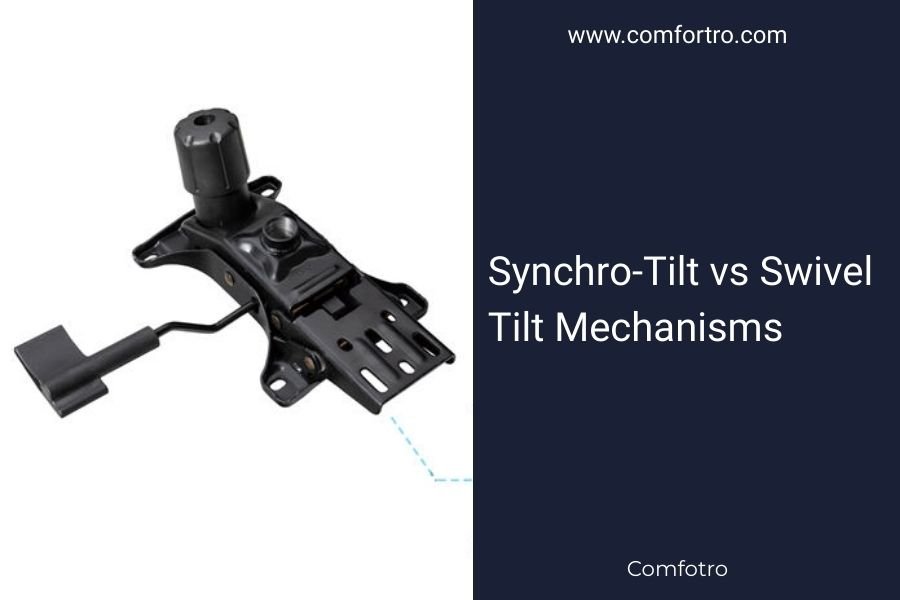
Synchro-tilt mechanisms let your entire seat pan and backrest tilt together in a fixed ratio, while swivel tilt mechanisms allow only the backrest to recline independently of the seat.
The main difference between these chair mechanisms is movement: synchro-tilt creates a rocking motion that keeps your thighs level, while swivel tilt lets you lean back without changing your seat angle.
What Are Chair Tilt Mechanisms?
Chair tilt mechanisms control how your office chair moves when you lean back. Think of them as the engine that powers your chair’s comfort.
Every office chair has some type of tilt system. The mechanism determines whether you get a smooth rocking motion or a simple backrest recline.
Why Tilt Mechanisms Matter for Your Comfort
Your spine changes shape throughout the day. A good tilt mechanism helps your chair adapt to these natural movements.
Poor tilt systems can cause back pain, leg numbness, and fatigue. The right mechanism supports your body’s need to shift and move.
Synchro-Tilt Mechanisms Explained
Synchro-tilt moves your seat and backrest together as one unit. When you lean back, both parts tilt at the same time.
The typical ratio is 2:1 or 3:1. For every 3 degrees your backrest moves, your seat tilts 1 degree forward.
How Synchro-Tilt Works
Picture a rocking chair’s motion. That’s what synchro-tilt recreates in your office chair.
The mechanism uses a pivot point under the seat. This creates the coordinated movement between seat and backrest.
The Science Behind the Motion
Research from ergonomic studies shows this motion keeps your hip angle open. This reduces pressure on your lower back muscles.
Your thighs stay roughly parallel to the floor. This prevents the blood pooling that causes leg discomfort.
Benefits of Synchro-Tilt Chairs
You get better blood circulation with synchro-tilt. The rocking motion encourages micro-movements throughout your day.
Your feet stay planted on the floor. This gives you better stability and control.
- Reduces pressure on your spine
- Keeps proper hip angle when reclining
- Maintains good leg circulation
- Feels more natural than fixed positions
Who Benefits Most from Synchro-Tilt?
Tall people love synchro-tilt because it prevents the seat edge from cutting into their legs. The forward seat tilt creates more clearance.
If you sit for 6+ hours daily, this mechanism reduces fatigue better than static positions.
Swivel Tilt Mechanisms Explained
Swivel tilt only moves the backrest. Your seat stays completely level while you recline.
Think of a recliner at home. The seat doesn’t move, but the back portion tilts away from you.
How Swivel Tilt Functions
The pivot point sits right behind your hip area. This allows the backrest to rotate independently.
You can lean back 15-30 degrees typically. The seat pan remains flat and stable.
The Mechanics Behind Swivel Tilt
A simple hinge mechanism connects the seat to the backrest. Springs or gas cylinders control the resistance.
Some models lock in different positions. Others provide continuous free-floating movement.
Benefits of Swivel Tilt Chairs
You get a stable work surface with swivel tilt. Your desk height relationship never changes.
The mechanism is simpler and often more reliable. Fewer moving parts mean less can break.
- Consistent desk positioning
- Simple and reliable design
- Usually costs less than synchro-tilt
- Good for task-focused work
Best Users for Swivel Tilt
People doing detailed work prefer swivel tilt. Your eye level and arm position stay consistent.
Shorter individuals often find swivel tilt more comfortable. There’s no risk of losing floor contact.
Direct Comparison: Synchro-Tilt vs Swivel Tilt
| Feature | Synchro-Tilt | Swivel Tilt |
|---|---|---|
| Movement Type | Seat and back together | Backrest only |
| Typical Cost | Higher | Lower |
| Complexity | More parts | Simpler design |
| Ergonomic Support | Better for long sitting | Good for focused tasks |
| Foot Contact | Maintains floor contact | May lift feet slightly |
Comfort Differences You’ll Notice
Synchro-tilt feels more like natural body movement. Your whole torso shifts as one unit.
Swivel tilt creates a bend at your hips. Some people find this less natural feeling.
Pressure Point Analysis
Research from occupational health studies shows synchro-tilt distributes pressure more evenly. Your weight shifts along your entire back surface.
Swivel tilt concentrates pressure at your hip crease. This can cause discomfort during long sitting sessions.
Workspace Integration
Swivel tilt keeps you in the exact same spot relative to your desk. Your monitor distance never changes.
Synchro-tilt moves you slightly forward and back. You might need to adjust your setup initially.
Making Your Choice
Consider how you work. Do you lean back often, or stay upright most of the time?
Think about your sitting duration. Longer sessions typically benefit more from synchro-tilt movement.
Budget Considerations
Synchro-tilt chairs typically cost 20-40% more than swivel tilt models. The extra mechanism complexity drives up manufacturing costs.
But the investment might pay off in comfort if you’re a heavy chair user.
Long-Term Value
Both mechanisms can last years with proper care. Synchro-tilt has more parts that could potentially wear out.
From what I researched, quality synchro-tilt chairs hold up well with regular office use.
Testing Before Buying
Sit in both types for at least 10 minutes. Pay attention to how the movement feels.
Try leaning back and forward. Does the motion feel smooth and supportive?
What to Look For
Good synchro-tilt should feel like a gentle rocking motion. Jerky or uneven movement suggests poor quality.
Quality swivel tilt provides smooth backrest control. You shouldn’t fight the mechanism to find a comfortable position.
Common Problems and Solutions
Synchro-tilt chairs sometimes develop squeaks or roughness. Regular lubrication of pivot points usually fixes this.
Swivel tilt mechanisms can lose tension over time. Most models have adjustment screws to restore proper resistance.
Maintenance Tips
Clean around the mechanism monthly. Dust and debris can interfere with smooth operation.
Don’t force stuck tilt mechanisms. Check for obstructions first, then consider professional repair.
Conclusion
Your choice between synchro-tilt and swivel tilt depends on your work style and comfort needs. Synchro-tilt offers more natural movement and better long-term ergonomics, while swivel tilt provides simplicity and consistent workspace positioning. Consider your daily sitting hours, work tasks, and budget to make the right decision. Both mechanisms can serve you well when matched to your specific needs.
Which mechanism is better for back pain?
Synchro-tilt generally provides better support for back pain sufferers because it maintains proper hip angles and reduces spinal pressure. The coordinated movement keeps your spine in better alignment throughout the day.
Can you add a synchro-tilt mechanism to an existing chair?
No, you cannot retrofit a swivel tilt chair with synchro-tilt. The mechanisms require completely different frame designs and mounting systems. You’d need to buy a new chair with the desired mechanism.
Do synchro-tilt chairs work well for shorter people?
Shorter individuals can use synchro-tilt chairs successfully, but they should test the chair first. Some may prefer swivel tilt to avoid any potential loss of foot contact when the seat tilts forward slightly.
How much weight can these tilt mechanisms handle?
Both mechanisms typically support 250-300 pounds in standard office chairs. Heavy-duty versions can handle up to 500 pounds. Always check the manufacturer’s weight rating before purchasing.
Which mechanism lasts longer with daily use?
Swivel tilt mechanisms often last longer because they have fewer moving parts. Quality synchro-tilt systems are also durable, but the additional complexity means more potential wear points over time.