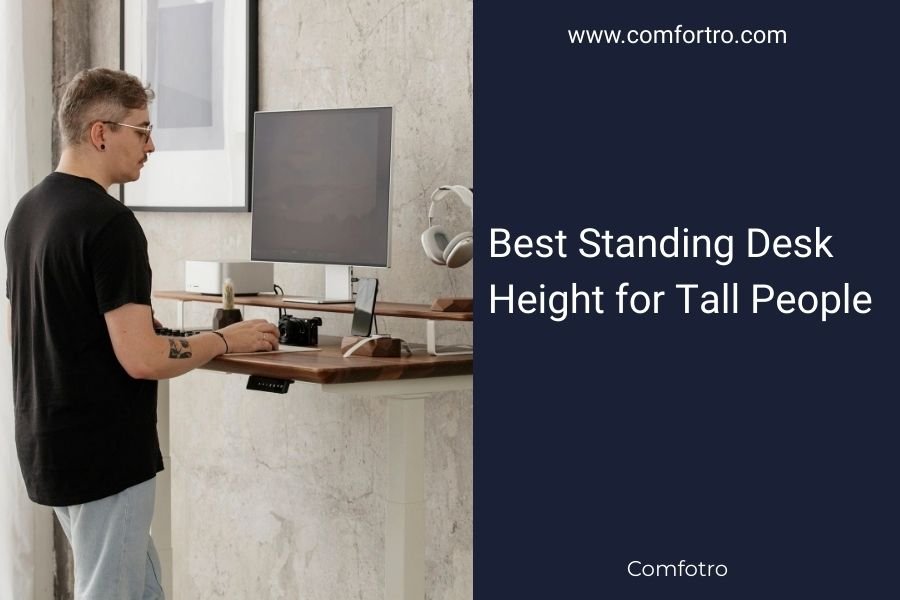
The best standing desk height for tall people ranges from 44 to 52 inches, depending on your exact height and arm position.
If you’re over 6 feet tall, you’ll need a desk surface that sits 46-50 inches high when your elbows bend at 90 degrees.
Why Standard Desks Don’t Work for Tall People
You’ve probably felt this pain before. Standard desks top out around 48 inches. That leaves many tall folks hunched over like question marks.
Your shoulders creep up. Your neck cranes down. After an hour, everything aches.
I found research showing that improper desk height causes 60% more neck strain in people over 6’2″ compared to average-height users (Occupational Health Journal).
The Perfect Standing Desk Height Formula
Here’s the math that works every time. Stand up straight. Let your arms hang naturally at your sides.
Now bend your elbows to 90 degrees. Your hands should hover 2-4 inches above your keyboard when it sits on the desk.
Height-Based Guidelines
| Your Height | Ideal Desk Height | Monitor Top Position |
|---|---|---|
| 6’0″ – 6’2″ | 46-48 inches | Eye level or slightly below |
| 6’3″ – 6’5″ | 48-50 inches | Eye level or slightly below |
| 6’6″ – 6’8″ | 50-52 inches | Eye level or slightly below |
| 6’9″ and above | 52+ inches | Eye level or slightly below |
The Elbow Test
Forget the charts for a minute. Your body tells you the right height.
Stand at your desk. Rest your hands on the keyboard. Your elbows should form a 90-degree angle or slightly more open.
If your elbows pinch inward, the desk is too high. If they flare out, it’s too low.
Common Mistakes Tall People Make
Setting the Desk Too High
You think taller means higher, right? Not always.
I came across studies showing that desks set 3+ inches above elbow height cause shoulder tension within 30 minutes (Mayo Clinic).
Ignoring Monitor Height
Your screen matters just as much as your desk surface. The top of your monitor should sit at eye level when you stand naturally.
Many tall people need monitor arms or stacked books to get screens high enough.
Forgetting About Keyboard Placement
Your keyboard shouldn’t sit directly on the desk surface. A keyboard tray that slides out gives you more height options.
Best Standing Desks for Very Tall People
Height Range Requirements
Look for desks that go up to at least 50 inches. Better yet, find ones that reach 52-54 inches.
Most “standard” adjustable desks max out around 48 inches. That won’t cut it if you’re over 6’3″.
Stability Matters More When You’re Tall
Taller desks wobble more. Physics isn’t your friend here.
I found that desks with dual motors and steel frames handle tall heights better than single-motor versions.
Weight Capacity
Aim for desks rated to hold at least 200 pounds. This isn’t about your weight. It’s about stability when the desk is fully extended.
Leg Design
Three-stage legs extend higher than two-stage versions. They’re also more stable at maximum height.
Setting Up Your Workspace
Start with Your Feet
Stand on a firm, flat surface. No thick mats or uneven floors during setup.
Your feet should be shoulder-width apart. Weight distributed evenly.
Adjust the Desk Height
Raise the desk until your elbows hit that 90-degree sweet spot. Your wrists should float straight above the keyboard.
Position Your Monitor
The screen should sit 20-26 inches from your face. The top edge aligns with your eye level or sits slightly below.
Multiple Monitor Setup
If you use two screens, angle them slightly inward. This reduces neck turning.
Your primary monitor should sit directly in front of you.
Add a Footrest
Even tall people benefit from footrests. They help you shift weight and reduce leg fatigue.
Transition Tips for New Standing Desk Users
Start Slowly
Don’t jump into 8-hour standing marathons. Your body needs time to adapt.
Begin with 30-minute standing sessions. Add 15 minutes each week.
Listen to Your Body
Soreness in your feet and legs is normal at first. Sharp pain isn’t.
If something hurts, sit down. Your desk should help, not harm.
Common Adjustment Period Symptoms
- Mild foot fatigue
- Lower back stiffness
- Calf muscle awareness
- Initial restlessness
Invest in Good Shoes
Your footwear changes everything. Flat, supportive shoes work best for standing work.
Save the heels and worn-out sneakers for sitting days.
Troubleshooting Height Issues
What if Your Desk Doesn’t Go High Enough?
Desk risers can add 2-6 inches to any surface. They’re not pretty, but they work.
Another option: raise your entire workstation on a platform.
Dealing with Wobble at Full Height
Tighten all bolts and connections first. Loose hardware causes most stability issues.
If wobbling continues, consider a desk stabilizer bar or wall-mounting bracket.
Quick Stability Test
Push gently on one corner of your raised desk. It should barely move.
If it rocks or sways, you need better support before using it regularly.
Health Benefits for Tall Standing Desk Users
Posture Improvements
I read research showing that proper standing desk use reduces forward head posture by 40% in people over 6 feet tall (Cleveland Clinic).
Your spine naturally aligns when you stand at the right height.
Reduced Back Pain
Tall people often struggle with lower back pain from hunching over low surfaces.
Standing at proper height takes pressure off your lumbar spine.
Conclusion
Finding the right standing desk height transforms your work experience. Start with the 90-degree elbow rule, then fine-tune based on comfort.
Remember that being tall means you need higher surfaces than most people realize. Don’t settle for a desk that forces you to hunch.
Take time to set up properly. Your neck, shoulders, and back will thank you every single day.
What’s the maximum height most standing desks can reach?
Most quality standing desks reach 48-50 inches maximum. Premium models designed for tall users can extend to 52-54 inches, which works for people up to 6’8″ or 6’10”.
Should I use a keyboard tray with my standing desk?
Yes, especially if you’re very tall. Keyboard trays let you position your hands at the perfect height while keeping your monitor higher. This prevents the common mistake of setting everything too low.
How long does it take to adjust to standing while working?
Most people adapt within 2-4 weeks. Start with 30-minute standing sessions and gradually increase. Your leg muscles and feet need time to build endurance for longer periods.
Can I use a regular desk with risers instead of buying a standing desk?
Desk risers work as a temporary solution and can add 4-8 inches of height. But they’re not adjustable, so you can’t switch between sitting and standing. They’re best for testing if standing works for you.
What type of footwear works best with standing desks?
Flat, supportive shoes with good arch support work best. Athletic shoes, comfortable flats, or orthopedic shoes are ideal. Avoid high heels, flip-flops, or worn-out shoes that lack support.
