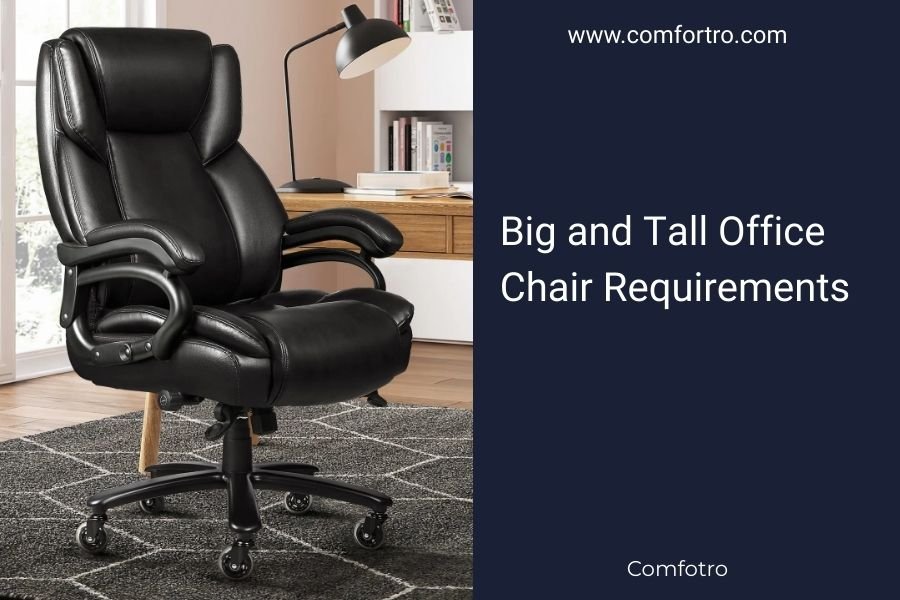
Big and tall office chair requirements include a weight capacity of 300-500+ pounds, seat dimensions of 22-26 inches wide, and adjustable height ranges that accommodate users up to 6’8″ tall.
You also need reinforced frames, heavy-duty gas cylinders, wider armrests, and deeper seats (20-24 inches) to ensure proper support and comfort for larger body types.
Weight Capacity: Your First Priority
Your chair’s weight limit isn’t just a number on a spec sheet. It determines how long your chair will last and how safe you’ll feel using it.
Standard office chairs typically support 250 pounds. Big and tall chairs start at 300 pounds and go up to 500+ pounds. Some heavy-duty models handle 800 pounds or more.
I found that many manufacturers test their chairs at 1.5 times the stated capacity. This gives you a safety buffer, but don’t push it.
How to Choose the Right Weight Rating
Add 50-75 pounds to your body weight when selecting a chair. This accounts for movement, leaning, and long-term durability.
If you weigh 280 pounds, look for chairs rated at 350+ pounds. Your chair will last longer and feel more stable.
Seat Dimensions That Actually Fit
Ever tried squeezing into a chair that’s too narrow? It’s uncomfortable and looks awkward. Big and tall chairs solve this problem with proper sizing.
Seat Width Requirements
Standard chairs offer 17-20 inches of seat width. You need 22-26 inches for comfortable seating.
Your hips should have 2-3 inches of space on each side. This prevents pressure points and allows natural movement.
Seat Depth Matters Too
Big and tall chairs provide 20-24 inches of seat depth compared to 16-18 inches in standard models.
Proper depth supports your thighs without putting pressure behind your knees. You should have 2-4 inches between the seat edge and your knees.
Quick Seat Fit Test
Sit all the way back in the chair. Can you fit 2-3 fingers between the seat edge and your knees? Perfect. Less space means the seat is too deep.
Height Adjustability for Taller Users
Standard chairs max out around 21-22 inches in seat height. That leaves taller people with their knees hitting their desk.
Big and tall chairs offer extended height ranges, typically 18-26 inches. Some models go even higher for users over 6’5″.
Getting Your Height Right
Your feet should rest flat on the floor with your thighs parallel to the ground. Your elbows should be at 90 degrees when typing.
If you’re over 6’2″, you probably need the extended height range that big and tall chairs provide.
Frame Construction and Durability
Think of your chair frame like the foundation of a house. It needs to be strong enough to handle daily use for years.
Steel vs. Aluminum Frames
Steel frames handle more weight but add bulk. Aluminum frames are lighter but have lower weight limits.
Most big and tall chairs use heavy-gauge steel for the base and reinforcement points. This provides the strength you need without unnecessary weight.
Reinforcement Points to Look For
- Extra welding at stress points
- Thicker metal tubing
- Additional support brackets
- Heavy-duty swivel mechanisms
Gas Cylinder Specifications
Your chair’s gas cylinder does more than adjust height. It supports your full weight every time you sit down.
Standard cylinders use Class 2 or Class 3 ratings. Big and tall chairs need Class 4 cylinders for proper support and longevity.
Signs of a Quality Cylinder
Look for cylinders with larger diameters (typically 3+ inches). They handle weight better and adjust more smoothly.
The cylinder should hold your preferred height without slowly sinking during the day.
Armrest Requirements for Larger Users
Standard armrests are too narrow and often too low for bigger users. You need wider, more adjustable options.
Width and Padding
Big and tall armrests should be 3-4 inches wide with thick padding. This distributes weight better and feels more comfortable.
Fixed armrests limit your seating options. Look for adjustable width, height, and angle settings.
Armrest Height Guidelines
Your arms should rest comfortably with shoulders relaxed. Too high creates tension. Too low makes you slouch.
Backrest Support for Different Body Types
A good backrest supports your spine’s natural curve. Big and tall chairs need taller, wider backrests to do this properly.
Lumbar Support Positioning
Taller people need adjustable lumbar support that moves up and down. Your lower back curve sits higher than average-height users.
The lumbar support should hit the small of your back, not your mid-back or tailbone area.
Backrest Height Requirements
Standard backrests top out around 24 inches. Big and tall users often need 26-30 inches for proper shoulder and upper back support.
Material and Cushioning Considerations
Your chair’s materials affect comfort, durability, and maintenance. Different body types have different needs here.
| Material Type | Benefits | Drawbacks |
|---|---|---|
| Memory Foam | Conforms to body shape | Can retain heat |
| High-Density Foam | Maintains shape over time | Firmer feel initially |
| Mesh Backing | Breathable and cool | Less cushioning |
Fabric Durability for Heavy Use
Commercial-grade fabrics last longer under daily stress. Look for fabrics rated for 100,000+ double rubs.
Leather and vinyl are easy to clean but can get hot in warm offices.
Mobility and Caster Requirements
Standard casters struggle under heavier weights. You need heavy-duty wheels that roll smoothly and won’t damage your floors.
Caster Weight Ratings
Each caster should handle at least 100 pounds. Five casters means 500 pounds total capacity.
Ball-bearing casters roll better than plastic sleeve bearings, especially under weight.
Floor Protection Matters
Hard casters work on carpet. Soft casters protect hard floors. Some big and tall chairs include both types.
Conclusion
Finding the right big and tall office chair means matching specific requirements to your body type and work habits. Focus on weight capacity, seat dimensions, height adjustability, and quality construction. Don’t settle for a standard chair that almost fits. Your comfort, health, and productivity depend on getting these requirements right. Take time to measure your needs and compare options carefully before buying.
What’s the difference between big and tall chairs and heavy-duty chairs?
Big and tall chairs accommodate both larger dimensions and greater heights, while heavy-duty chairs focus mainly on weight capacity. Big and tall models offer wider seats, taller backrests, and extended height ranges that heavy-duty chairs might not include.
How do I measure myself for a big and tall office chair?
Measure your hip width, thigh length from hip to knee, and floor-to-knee height while sitting. Add 4-6 inches to hip width for seat width, 2-4 inches to thigh length for seat depth, and use your floor-to-knee measurement for minimum seat height.
Can big and tall chairs fit through standard doorways?
Most big and tall chairs fit through standard 32-36 inch doorways, but some extra-wide models might be tight. Check the chair’s overall width with armrests before ordering, especially for narrow office doors or hallways.
Do big and tall chairs require special desk heights?
Not usually, but taller users might need adjustable desks. Standard 29-30 inch desk heights work fine if your chair adjusts high enough to maintain proper arm and wrist positioning while typing.
How long do big and tall office chairs typically last?
Quality big and tall chairs last 7-10 years with normal use, similar to high-end standard chairs. The key is choosing a chair with appropriate weight capacity and quality components rather than pushing a lower-rated chair to its limits.