9 Best HBADA Ergonomic Office Chairs (November 2026)
The best HBADA ergonomic office chairs include the GABRYLLY Ergonomic Office Chair for a wide seat and flip-up arms, the ELABEST X100 Ergonomic Mesh Office Chair for maximum adjustment range, and the SIHOO B300 Pro Ergonomic Office Chair Without for adaptive lumbar support.
On this page (4 sections)
The best HBADA ergonomic office chair for most buyers is the Hbada P5, because it combines adjustable 3D lumbar support, a 2D headrest, mesh seating, adjustable armrests and a footrest.
The Hbada E3 Pro is the stronger choice for a broader height range and deeper recline adjustment.
That pairing gives HBADA buyers a clear starting point, with the P5 aimed at everyday balance and the E3 Pro aimed at wider fit and more positions.
HBADA is only part of this comparison.
We also checked similar ergonomic chairs so you can see where HBADA's adjustment choices fit against wider seats, foam cushions, more flexible armrests and higher stated weight limits.
Those alternatives matter because the best chair for you may not come from the brand you searched for first.
A wider seat, a foam cushion or deeper armrest movement can change daily comfort more than the logo on the side.
If you need a chair for a dedicated work room, compare these picks with our guide to the Best Ergonomic Office Chair For Home Office.
For long gaming sessions, our Best Ergonomic Office Chair For Gaming guide covers the features that matter after work.
Use the home office guide when the chair will carry your main workday.
Use the gaming guide when the same seat has to support long sessions, frequent posture shifts and relaxed breaks.
Start with height and seat depth before you judge extra controls.
A chair that fits your desk and legs will feel better than a chair with more adjustments that sit in the wrong place.
Then look at lumbar support, armrests and recline in that order.
Those three areas decide how the chair follows you through typing, reading, calls and rest.
Our picks at a glance
-
1
 Best for a wide seat and flip-up arms
GABRYLLY Ergonomic Office Chair
9.7/10 our score
See it on Amazon -
2
 Best for maximum adjustment range
ELABEST X100 Ergonomic Mesh Office Chair
9.5/10 our score
See it on Amazon -
3
 Best for adaptive lumbar support
SIHOO B300 Pro Ergonomic Office Chair Without
9.4/10 our score
See it on Amazon
- 4
 Check it
TRALT Office Chair Ergonomic Desk Chair
Best for a foam seat and mesh back - 5
 Best for compact desk spacesCheck it
- 6
 Check it
HOLLUDLE Ergonomic Mesh Office Chair
Best for a wide adjustable back - 7
 Check it
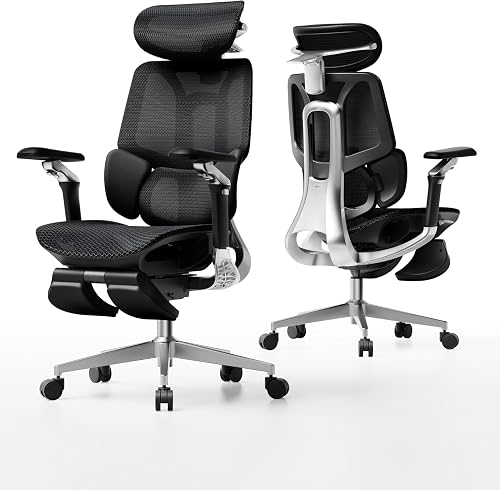
Hbada P5 Ergonomic Office Chair
Best for balanced HBADA comfort - 8
 Check it
Hbada E3 Pro 2026 Edition Ergonomic Office
Best for the widest user fit - 9
 Check it
FLEXISPOT ErgoX Premium Ergonomic Office Chair Black-FT
Best for office and gaming-room use
The best HBADA ergonomic office chairs and alternatives
The best choice depends on the adjustment you will use most. The Hbada P5 offers the most balanced HBADA setup, while the E3 Pro targets buyers who need more range in the headrest, lumbar support, armrests and recline.
Our score weighs specifications, adjustment features and buyer feedback against what you are shopping for. The scores are comparison scores, not a promise that every chair will fit every body.
GABRYLLY Ergonomic Office Chair: Best for a wide seat and flip-up arms
- 300 lb capacity
- 90–120° tilt
- 3D headrest
- Flip-up arms
The GABRYLLY combines a wide cushion, mesh back and seat, a 3D headrest, flip-up arms and a 90–120° tilt range.
Pros
- Wide seat
- 300 lb capacity
- Flip-up arms save desk space
Cons
- Recommended height range is 5'2" to 6'1"
- Not an HBADA model
The GABRYLLY leads this list because its wide cushion, headrest, flip-up arms and mesh seat cover several common home-office needs. The chair is recommended for users about 5'2" to 6'1", with a 300 lb capacity and a seat height from 18.9 to 23.6 inches.
Its back and seat use mesh for airflow, while the 90–120° recline range gives you an upright work position and a modest lean-back position. The 3D headrest and adjustable lumbar support give you more contact points than a basic task chair.
Flip the arms up when you need to push the chair under the desk. That matters in smaller rooms where the chair has to share floor space with storage or another seat.
Choose it if you want a wide, breathable chair with simple space-saving arms. Its recommended height range is narrower than the Hbada E3 Pro, so taller buyers should compare the fit carefully.
ELABEST X100 Ergonomic Mesh Office Chair: Best for maximum adjustment range
- 5D flip-up arms
- 3D lumbar support
- 18 in footrest
- 3-stage recline
The ELABEST X100 offers extensive arm, lumbar and headrest adjustments, plus a footrest and 3-stage recline.
Pros
- 5D armrests
- Adjustable footrest
- BIFMA-certified structure
Cons
- More adjustment points require more setup
- Not an HBADA model
The ELABEST X100 is the most adjustment-heavy chair here.
Its 5D flip-up arms move in height, width, forward and backward position, rotation and flip direction, while the 3D lumbar support adds height, depth and rotation adjustment.
The chair includes an 18 in extendable footrest with 2-position angle adjustment.
Its 3-stage recline lets you shift from focused work to a more relaxed position without using a separate foot stool.
The seat height runs from 18.3 to 23 inches, and the BIFMA-certified structure supports up to 300 lb.
ELABEST also describes the chair as suitable for both home-office and gaming use.
That dual use suits people who work at a desk by day and game in the same room at night.
The headrest and lumbar controls are the parts to set first, since they shape neck and lower back support.
Armrest position comes next, and it should keep your shoulders relaxed while you type or hold a controller.
This is a strong alternative when you want to tune the chair closely to your arms and lower back.
The trade-off is that more adjustment points take more time to set up and maintain.
If you share the chair, label your settings or reset it after each use so the fit stays consistent.
SIHOO B300 Pro Ergonomic Office Chair Without: Best for adaptive lumbar support
- 4D lumbar support
- Adjustable backrest
- Adjustable seat depth
- 135° recline
The SIHOO B300 Pro uses adjustable seat depth, backrest height and spring-assisted 4D lumbar support for a customized fit.
Pros
- Seat-depth adjustment
- Weight-sensing recline
- 6D armrests
Cons
- No footrest
- Not an HBADA model
The SIHOO B300 Pro is the best alternative for buyers who want the seat itself to adapt to leg length.
Its seat depth adjusts from 16.53 to 18.5 inches, while the backrest height also adjusts independently.
Its spring-assisted 4D lumbar support moves in height and forward position and flexes with your body.
The weight-sensing mechanism adjusts recline resistance automatically, with a maximum recline of 135°.
The 6D flip-up armrests rotate, slide and lift to support different arm positions.
The chair also has an oversized 3D headrest and a breathable mesh seat.
Seat depth is easy to overlook, yet it changes thigh support and pressure behind the knees.
Taller users often need more depth, while shorter users can feel crowded when a seat runs too long.
Setting depth before lumbar support helps you judge the full fit in one pass.
Choose it if seat depth is a deciding factor.
Choose the Hbada P5 instead if an included footrest matters more than adaptive recline and deeper fit adjustment.
TRALT Office Chair Ergonomic Desk Chair: Best for a foam seat and mesh back
- Adjustable lumbar depth
- High-resilience molded foam seat
- 330 lb capacity
- 17.7–21.7 in seat height
The TRALT pairs a molded foam seat with a breathable mesh back, adjustable lumbar depth and a reinforced base with a metal core.
Pros
- 330 lb capacity
- Foam seat
- Adjustable lumbar depth
Cons
- No manufacturer warranty
- Not an HBADA model
The TRALT uses a different comfort mix from the mesh-heavy picks.
It has a high-resilience molded foam seat, a breathable mesh back and adjustable lumbar depth.
Its 19.7 in wide seat is 17.3 inches deep, and the seat height ranges from 17.7 to 21.7 inches.
TRALT states a 330 lb capacity and describes the reinforced base as having a metal core.
The white finish gives it a lighter look than the black HBADA chairs.
That lighter color can suit a bright room, though it may show marks more readily than a dark finish.
Foam gives a more cushioned feel under the thighs, while mesh keeps the back cooler during long sessions.
The lumbar mechanism is the main adjustment to focus on, since the information does not describe the same level of headrest and armrest movement as the leading picks.
A simple care routine helps foam keep its shape, so avoid leaving heavy items on the seat when it is not in use.
Choose it if you prefer a foam seat with a mesh back.
Before buying, compare the lower maximum seat height with your desk and leg length.
NEO CHAIR Office Desk Chair: Best for compact desk spaces
- Flip-up arms
- Adjustable height
- Tilt tension
- 360-degree swivel
The NEO CHAIR keeps the feature set simple with mesh support, flip-up arms, height adjustment, tilt tension and swivel movement.
Pros
- Compact dimensions
- Flip-up arms
- SGS-certified gas lift
Cons
- Less lumbar adjustment than the leading picks
- Not an HBADA model
The NEO CHAIR is a compact option for a desk where floor space is tight.
Its chair dimensions are 22 x 23.5 x 40 inches, and the flip-up arms let you move it closer to or under the desk.
The mesh back supports airflow, while seat-height adjustment, tilt tension and 360-degree swivel cover the basic movement needs of a daily desk chair.
Its grey finish also works well with a lighter office setup.
Compact size is the main reason to pick this chair over wider alternatives.
It can fit a small spare room, a narrow desk or a shared space where the chair must move aside after work.
The controls stay simple, which suits people who do not want many settings to manage.
That simplicity also means less room to fine tune support for different body shapes.
This chair does not offer the same detailed lumbar adjustment as the Hbada P5 or E3 Pro.
It is better for buyers who want a straightforward chair with fewer settings to manage.
Choose it for a compact workspace and simple controls.
If your lower back needs a more precise fit, move up to a chair with adjustable lumbar depth, height or movement.
HOLLUDLE Ergonomic Mesh Office Chair: Best for a wide adjustable back
- 3D lumbar support
- 2D headrest
- 3D armrests
- 3-level tilt lock
The HOLLUDLE focuses on a wide mesh V-back, 3D lumbar adjustment, a 2D headrest and 3D armrests.
Pros
- Wide backrest
- 3D lumbar adjustment
- 5-year warranty
Cons
- Assembly takes about 20–30 minutes
- Not an HBADA model
The HOLLUDLE is a wide-back alternative with a 20.28 in backrest.
Its 3D lumbar support adjusts up, down, forward, backward and by rotation, while the 2D headrest moves up, down and rotates.
The 3D armrests adjust in height, move forward and backward and rotate.
A 3-level tilt lock lets you choose among work, reading and relaxation positions.
Its V-back mesh design gives the chair a distinct look, and HOLLUDLE describes the chair as meeting BIFMA and EN1335 standards.
Assembly takes about 20–30 minutes with the included tools.
A wide back can feel more supportive across the shoulders and upper back.
It may also take more floor space, so check the chair footprint against your desk area before ordering.
The tilt lock is useful when you want a set position rather than free movement.
Locking the chair can help during focused work, while a looser setting suits reading or breaks.
Choose it if back width and lumbar movement matter most.
The Hbada E3 Pro has a broader stated user-height range, but the HOLLUDLE gives you a clear set of back and arm adjustments.
Hbada P5 Ergonomic Office Chair: Best for balanced HBADA comfort
- 3D lumbar support
- 2D headrest
- Footrest
- Adjustable height
The Hbada P5 gives you a practical mix of adjustable lumbar support, a 2D headrest, 3D armrests, mesh seating and a footrest.
Pros
- Footrest included
- 3D lumbar adjustment
- 3-year warranty
Cons
- Product dimensions vary across the supplied fields
- Fewer recline details than the E3 Pro
The Hbada P5 is the best balanced HBADA chair in this group.
It has 3D lumbar support, a 2D headrest, adjustable-height armrests, breathable mesh and an included footrest.
The lumbar support adjusts in height, depth and width.
Hbada recommends the chair for users from 5'4" to 6'2", which gives it a practical fit range for many adult home-office users.
The footrest is useful when you want to take a short break without leaving the chair.
Its mesh construction also suits people who prefer airflow over a fully upholstered back.
The P5 suits a regular workday where you move between typing, calls and short pauses.
Its adjustment layout feels familiar, so there is less to learn during the first week of use.
Product dimensions appear differently across the supplied fields, so measure your desk area and confirm the final dimensions before ordering.
That check matters most for doorway clearance, desk depth and space behind the chair.
Choose the P5 when you want a familiar ergonomic layout without the more complex 720° armrest system of the E3 Pro.
Hbada E3 Pro 2026 Edition Ergonomic Office: Best for the widest user fit
- 3-zone floating lumbar support
- 4D headrest
- 720° armrests
- 140° recline
The Hbada E3 Pro has a wide adjustment range, 3-zone lumbar support, a 4D headrest, 720° armrests and four recline positions.
Pros
- Broad height range
- 140° maximum recline
- 5-year core-structure warranty
Cons
- Higher adjustment complexity
- Seat-depth field needs confirmation before ordering
The Hbada E3 Pro is the better HBADA pick for buyers who need the widest stated fit range.
Hbada describes it for users from 5'1" to 6'5", with adjustable backrest height, lumbar position and seat depth.
Its 3-zone floating lumbar support uses lateral wings that pivot from 40° to 80° and has 60 mm of vertical adjustment.
The 4D headrest adds 70 mm of depth adjustment, 40 mm of height adjustment and 70° of rotation.
The chair reclines through four positions, reaching 140°.
Its 720° armrests use dual 360° rotation and 39° folding, while the black CloudMesh material is designed for airflow.
That range helps households where more than one person uses the same chair.
Each user can move the lumbar pad and headrest instead of settling for a compromise fit.
The many controls also reward people who sit in several positions during the day.
Choose the E3 Pro if you will use several adjustments every day or share the chair with people of different heights.
Confirm the seat-depth measurement before ordering because the supplied seat-depth field does not match the chair's other adjustment details.
FLEXISPOT ErgoX Premium Ergonomic Office Chair Black-FT: Best for office and gaming-room use
- 17–20 in adjustable seat depth
- Dynamic lumbar support
- 3D headrest
- Nap footrest
The FLEXISPOT ErgoX combines a dynamic lumbar system, adjustable seat depth, 3D armrests, a headrest and a nap footrest.
Pros
- 400 lb capacity
- Adjustable seat depth
- 3-year warranty
Cons
- Seat height starts at 20.1 in
- Not an HBADA model
The FLEXISPOT ErgoX is a strong alternative for a larger user or a workspace that also serves as a gaming room.
It has a stated 400 lb capacity, adjustable seat depth from 17 to 20 inches and a seat height from 20.1 to 22.4 inches.
Its dynamic lumbar support, 5-level adjustable back, 3D headrest and 3D armrests cover the main posture adjustments.
A nap footrest adds a place to support your legs during breaks.
FLEXISPOT recommends it for users from 5'1" to 6'2".
The starting seat height of 20.1 inches may be high for shorter users, so compare your desk height and foot position before choosing it.
Seat depth adjustment can help larger users get fuller thigh support.
It can also help when you move between an upright work pose and a relaxed recline.
The higher capacity gives more headroom for heavier users, though fit still depends on shoulder width and leg length.
Choose it if capacity and seat-depth adjustment are more important than having an HBADA brand.
Its 3-year warranty covers the entire chair.
How to choose an HBADA ergonomic office chair
The right HBADA ergonomic office chair should fit your body before you compare extra features. Start with your height, desk height, leg length and the adjustments you will actually use.
Match seat height to your desk
Your feet should rest flat while your knees remain comfortable. Compare the chair's height range with the underside of your desk, especially if you use a keyboard tray or a fixed-height work surface.
The Hbada P5 is recommended for users from 5'4" to 6'2". The E3 Pro covers a wider stated range from 5'1" to 6'5", but the wider range does not remove the need to check your desk and leg position.
Check lumbar support movement
A fixed lumbar pad gives you fewer ways to position support. The P5 offers 3D movement, while the E3 Pro adds a 3-zone system with lateral pivoting and 60 mm of vertical adjustment.
If you shift between leaning forward and reclining, a moving lumbar system may be more useful than a simple height-only pad. Make small adjustments until the support sits against your lower back without forcing you forward.
Decide if you need a footrest
A footrest is useful for short breaks, reading or relaxed sitting. The P5 includes one, and the E3 Pro includes a footrest in its title.
The alternative chairs vary, with some offering footrests and others focusing on seat-depth or armrest adjustment.
Do not choose a chair only because it includes a footrest. Check whether the seat height and recline range still suit your normal typing position.
Compare armrest adjustment
Armrests should support your forearms without lifting your shoulders. The P5 has adjustable armrests, while the E3 Pro uses 720° armrests with dual rotation and folding.
The GABRYLLY, ELABEST and SIHOO alternatives offer different armrest systems. If you move between typing, gaming and reading, more movement may help, but a simpler armrest can be easier to set once and leave alone.
Consider mesh, foam and room temperature
Mesh backs and seats allow airflow, which may suit a warm office.
Foam seats can feel more padded, as shown by the TRALT's molded foam seat.
The choice comes down to how you run hot during long sessions.
Mesh releases heat more easily and can feel lighter across the back.
Foam spreads pressure over a softer surface and may suit people who dislike a firmer seat.
The P5 and E3 Pro use mesh-focused designs.
If you prefer a cushioned seat, compare the TRALT or the FLEXISPOT configuration described with a cushioned foam seat.
Room temperature and clothing matter as much as the material itself.
A warm room with a mesh chair often feels more comfortable than the same room with heavy upholstery.
A cooler room may make a foam seat feel more inviting during winter.
For a different brand benchmark, see our guide to Best Herman Miller Office Chairs.
If you are taller than average, our Best Ergonomic Office Chair For Tall People guide adds more fit-focused options.
HBADA chair setup and care
Start by assembling the chair on a clear floor and tightening each connection according to its instructions.
Sit in the chair only after the base, casters, backrest, armrests and headrest are secure.
Keep the manual nearby during the first setup so you can check torque and part order.
A slow build makes later adjustments easier and reduces loose fittings.
Set the seat height before adjusting the lumbar support.
Then position the backrest, armrests and headrest so they support your working posture rather than forcing your shoulders or neck into a fixed position.
Change one setting at a time and sit for a few minutes after each change.
That habit makes it easier to tell which control improved comfort.
Small shifts in seat height can change armrest alignment, so check the arms again after the seat is set.
Keep mesh free of dust and avoid placing sharp objects against the seat or back.
Check screws and moving parts from time to time, especially if the chair develops movement or noise.
Wipe mesh with a soft cloth and avoid harsh cleaners that can weaken fibers or dull the finish.
Check casters for hair and debris, since a clean wheel rolls more smoothly on hard floors.
Use the Ergonomic Office Chair Adjustment Guide when you need a step-by-step setup order.
If you are comparing a racing-style chair with a task chair, read Gaming Chair vs Office Chair for Ergonomics before choosing a shape.
Revisit the setup after the first week, once your normal sitting habits settle in.
Verdict: which HBADA ergonomic office chair should you buy?
The Hbada P5 is the best HBADA ergonomic office chair for balanced home-office use, with 3D lumbar support, a 2D headrest, mesh construction and a footrest.
Pick the Hbada E3 Pro if you need the widest stated height range, four recline positions and more armrest movement.
The P5 is the safer first choice for most buyers.
It covers the main support points without asking you to manage a large number of controls.
The E3 Pro makes sense when fit range is the main problem.
It suits taller users, shorter users and shared desks where one chair must serve more than one person.
Pick GABRYLLY for a wide seat and flip-up arms, SIHOO for adjustable seat depth, TRALT for a foam seat and mesh back, or FLEXISPOT for a 400 lb capacity.
Each alternative solves a different fit problem.
Compare seat height and depth before you compare color or extra features.
The best chair is the one whose height, seat depth and support controls match your desk and body.
Our top 3 picks at a glance
-
1
Best for a wide seat and flip-up arms
GABRYLLY Ergonomic Office Chair
9.7/10 our score
See it on Amazon -
2
Best for maximum adjustment range
ELABEST X100 Ergonomic Mesh Office Chair
9.5/10 our score
See it on Amazon -
3
Best for adaptive lumbar support
SIHOO B300 Pro Ergonomic Office Chair Without
9.4/10 our score
See it on Amazon
Frequently asked questions
What is the best HBADA ergonomic office chair?
The Hbada P5 is the best HBADA ergonomic office chair for a balanced setup because it combines adjustable 3D lumbar support, a 2D headrest, 3D armrests, breathable mesh and an included footrest. Choose the E3 Pro if you need a wider height range and more recline positions.
Is HBADA good for an ergonomic office chair?
HBADA offers chairs with several useful ergonomic adjustments, including lumbar support, headrests, seat height, recline and armrest movement. The P5 is simpler to set up for everyday work, while the E3 Pro has more adjustment range.
Fit still depends on your height, desk and preferred sitting position.
What should I adjust first on an HBADA office chair?
Set the seat height first so your feet rest flat and your knees stay comfortable. Then adjust seat depth or backrest position, lumbar support, armrests and headrest.
Finish with recline tension and tilt settings.
Small changes are easier to judge when you change one setting at a time.
Is the Hbada P5 or E3 Pro better?
The Hbada P5 is the simpler choice if you want 3D lumbar support, a 2D headrest and a footrest for regular home-office use. The E3 Pro is better suited to buyers who want a 4D headrest, 720° armrests, four recline positions and a stated fit range from 5'1" to 6'5".


