7 Best Two-Piece Ergonomic Keyboards (November 2026)
The best ergonomic two-piece keyboards include the Logitech MK345 Full Size Wireless Keyboard for a full-size wireless setup, the Logitech Ergo K860 Wireless Ergonomic Split Keyboard for most ergonomic office desks, and the Cloud Nine C989M Ergonomic Mechanical Keyboard for mechanical key feel.
On this page (8 sections)
- The best ergonomic two piece keyboards by use
- How should you choose an ergonomic keyboard two pieces?
- Wired or wireless: which setup is easier?
- Do you need tenting with a split keyboard?
- What should you know about mechanical and membrane keys?
- How do you set up a split keyboard comfortably?
- More guides on this topic
- Verdict: which best ergonomic two piece keyboard should you buy?
The best ergonomic two piece keyboard for most users is the Logitech Ergo K860, because its curved split frame, pillowed wrist rest and adjustable palm lift make a familiar wireless office setup easier to adopt. Choose the Cloud Nine C989M for mechanical switches, or the Kinesis Freestyle2 when you need the keyboard halves separated widely.
A two-piece keyboard can mean two fully separate modules, or a joined frame with a split key layout. The key benefit is placement: you can move each side to suit your shoulder width instead of keeping both hands close together on a straight keyboard.
If you want a broader overview first, our desktop keyboard guide covers layouts, connections and desk-use choices. For the basic body-position difference, read our guide to Ergonomic Keyboard Split Layout: A Complete Guide for Comfort and Productivity.
Our picks at a glance
-
1
 Best for a full-size wireless setup
Logitech MK345 Full Size Wireless Keyboard
9.7/10 our score
See it on Amazon -
2
 Best for most ergonomic office desks
Logitech Ergo K860 Wireless Ergonomic Split Keyboard
9.7/10 our score
See it on Amazon -
3
 Best for mechanical key feel
Cloud Nine C989M Ergonomic Mechanical Keyboard
9.6/10 our score
See it on Amazon
- 4
 Check it
Kinesis Freestyle2 Ergonomic Keyboard for PC
Best for wide shoulder-width spacing - 5
 Check it
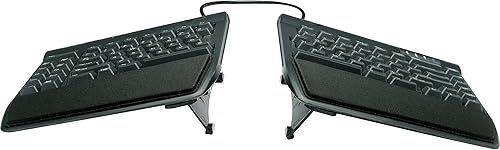
KINESIS Freestyle2 USB-A Ergonomic Keyboard w/ VIP3
Best for built-in tenting - 6
 Check it
RK ROYAL KLUDGE S70 Ergonomic Split Keyboard
Best for wireless mechanical flexibility - 7
 Best for a compact wired layoutCheck it
The best ergonomic two piece keyboards by use
The best ergonomic two piece keyboard depends on how far apart you want the halves, whether you prefer mechanical or membrane keys, and how much desk space you have. The Logitech Ergo K860 is the easiest general office pick, while the Kinesis and Cloud Nine models give you more physical separation.
Our score weighs specs, features and buyer feedback against what you're shopping for. Roundup scores are fixed across Comfortro, so the same product keeps the same score in future posts.
Logitech MK345 Full Size Wireless Keyboard: Best for a full-size wireless setup
- Full-size QWERTY layout
- Integrated palm rest
- 2.4 GHz wireless connection
- Keyboard and right-handed mouse combo
The MK345 is a full-size wireless keyboard and mouse combo rather than a true split keyboard. It suits buyers who want familiar keys, a palm rest and a simple wireless desk setup.
Pros
- Full-size layout
- Palm rest and media keys
- Keyboard batteries included
Cons
- Not a two-piece split design
- Mouse is right-handed
The Logitech MK345 is the outlier in this roundup because it is a full-size wireless keyboard and mouse combo, not a two-piece split keyboard. Choose it when your priority is a familiar QWERTY layout, integrated palm rest, media keys and a right-handed mouse.
Its 2.4 GHz wireless connection reaches up to 10 m, giving you a simple setup for a home or office desk. One USB-A Nano Receiver connects the keyboard and mouse, so the arrangement is less flexible than a true split design.
The keyboard has 104 keys and uses a full-size layout. Its battery life is up to 3 years for the keyboard and 18 months for the mouse, with 2 AA batteries included.
The MK345 works with Windows, macOS and ChromeOS. It is the right choice if you want wireless convenience and a standard layout, but it is not the pick for users who specifically need separate keyboard halves.
Logitech Ergo K860 Wireless Ergonomic Split Keyboard: Best for most ergonomic office desks
- Curved split keyframe
- Pillowed wrist rest
- Bluetooth and USB connectivity
- Adjustable palm lift
The Ergo K860 gives you a split keyframe with a full-size layout, wrist support and wireless connection. Its two halves are joined in one curved frame, so it is easier to place than a fully separate keyboard.
Pros
- Curved split design
- Built-in wrist rest
- Bluetooth and USB options
Cons
- Joined halves cannot be spread apart
- Full-size frame needs desk space
The Logitech Ergo K860 is the best starting point for most office users who want an ergonomic keyboard without learning a new key arrangement. Its curved split keyframe keeps the two sides joined, which makes it more stable and easier to move than a fully separate design.
The pillowed wrist rest gives your palms a consistent support surface. Logitech states that it provides 54% more wrist support and 25% less wrist bending than a standard keyboard without a palm rest.
Its palm lift has 0, -4 and -7 degree settings. That gives you a few ways to change the wrist angle while seated or standing.
Bluetooth and the included USB receiver give you two connection choices. If you also want easy-to-read key legends, compare Bluetooth large-print keyboards.
The keyboard works with Windows, macOS, Linux and Chrome OS, and its 78-button layout keeps the number pad and familiar QWERTY arrangement.
Pick the K860 if you want a joined ergonomic keyboard for daily office work. If you need to move the left and right halves independently, choose one of the fully separated Kinesis, Cloud Nine or Perixx models instead.
Cloud Nine C989M Ergonomic Mechanical Keyboard: Best for mechanical key feel
- Split mechanical layout
- Kailh tactile Brown switches
- RGB backlighting
- Up to 8 in separation
The Cloud Nine C989M combines a two-piece mechanical layout with built-in tenting, palm support, RGB lighting and programmable macro keys. It suits Windows users who want a wider split and tactile switches.
Pros
- Separates up to 8 in
- Built-in tenting and palm support
- Number pad and macro keys
Cons
- USB connection
- Designed for PC and Windows
The Cloud Nine C989M is the best ergonomic two piece keyboard here for users who want mechanical switches, built-in tenting and a full-size layout. Its two sections can separate up to 8 in, giving you more shoulder-width control than a joined frame.
Kailh tactile Brown switches give the keys a tactile feel. The keyboard also has RGB backlighting, a full number keypad, 10 programmable macro keys and a USB pass-through.
Its built-in tenting and 7 degree wrist-rest angle create a raised center position for the hands. That shape may suit users who prefer a more raised setup than a flat keyboard.
The C989M works with PCs and Windows. It is a strong fit for coding, office work or gaming when you want a mechanical feel, but its USB connection and Windows focus make it less flexible than the wireless models.
For a gaming-focused comparison, see our guide to the best split keyboard for gaming. The Cloud Nine is the best match here when macro keys, RGB lighting and a number pad matter.
Kinesis Freestyle2 Ergonomic Keyboard for PC: Best for wide shoulder-width spacing
- Up to 20 in separation
- Low-force membrane switches
- Standard Windows layout
- Embedded numeric 10-key
The Freestyle2 is built for buyers who need the two keyboard halves far apart. Its low-force membrane switches and standard Windows layout keep the design familiar while the extended cable gives you more placement freedom.
Pros
- Widest separation here
- Low-force membrane keys
- No software or special drivers required
Cons
- USB-A connection
- Tenting accessories are not pre-assembled
The Kinesis Freestyle2 is the best pick for buyers who need the widest separation between keyboard halves. Its modules can move up to 20 in apart, so you can place your hands closer to your natural shoulder width.
The keyboard uses low-force membrane switches with tactile feedback. Its standard Windows layout includes cut, copy, paste and multimedia keys, along with an embedded numeric 10-key.
The 20 in version includes a USB wired connection, an extended linking cable, a detachable pivot tether and a Quick Start Guide. It does not require special software or drivers for its standard layout.
This model gives you more spacing than the other keyboards here, but its tenting accessories are not pre-assembled. If you want to change the height of the keyboard, plan around that accessory choice.
Choose the Freestyle2 when spacing is your main concern. For a model that comes with tenting and palm supports already installed, consider the VIP3 version below.
KINESIS Freestyle2 USB-A Ergonomic Keyboard w/ VIP3: Best for built-in tenting
- Up to 9 in separation
- VIP3 lifters
- 5, 10 or 15 degree tenting
- Cushioned palm supports
This Freestyle2 version adds pre-installed VIP3 lifters and palm supports to the split design. It suits buyers who want adjustable tenting without adding the accessories separately.
Pros
- Three tenting angles
- Palm supports included
- Low-force membrane switches
Cons
- USB connection
- Shorter separation than the 20 in version
The KINESIS Freestyle2 with VIP3 is the best ergonomic keyboard two pieces here for buyers who want adjustable tenting from the start. The pre-installed VIP3 accessory gives you 5, 10 or 15 degree tenting and cushioned palm supports.
The two halves can separate up to 9 in. That is less than the 20 in Freestyle2, but it is enough to give many desks a wider hand position than a standard keyboard.
The low-force membrane switches use a standard Windows layout with an embedded numeric 10-key. The package includes the keyboard, VIP3 tenting accessory, palm supports, adhesive cushioned palm pads, a detachable pivot tether and a Quick Start Guide.
Its USB connection suits a fixed desk more than a flexible multi-device setup. Choose it when palm support and tenting matter more than Bluetooth or maximum separation.
Our guide to the best split keyboard with tenting covers similar setup choices. You can also compare it with the best tented ergonomic keyboards if a raised thumb-side angle is your main goal.
RK ROYAL KLUDGE S70 Ergonomic Split Keyboard: Best for wireless mechanical flexibility
- 75% split mechanical layout
- 2.4 GHz, Bluetooth and USB-C
- 8 adjustable feet
- Hot-swappable switches
The RK S70 is a compact split mechanical keyboard with wireless modes, adjustable feet, a fixed wrist rest and programmable macro keys. The right half needs a coiled or connecting cable to work.
Pros
- Three connection modes
- Hot-swappable PCB
- Compact 75% layout
Cons
- Right half cannot work alone
- Software is available for Windows only
The RK ROYAL KLUDGE S70 is the best wireless mechanical option for users who want a compact split keyboard with several connection modes. Its 75% layout has 74 buttons, keeping the keyboard smaller than full-size picks while retaining the split form.
You can connect it through 2.4 GHz wireless, Bluetooth or USB-C. The keyboard also has 8 adjustable feet, a fixed wrist rest, RGB lighting and 5 programmable macro keys on the left side.
The hot-swappable PCB supports 3-pin and 5-pin switches. Its pre-lubed linear creamy switches come installed, and the built-in 3150 mAh battery can last up to 2 weeks without backlight.
The left half can retain wireless connection and macro functions for one-handed use. The right half needs the coiled or connecting cable and cannot work alone.
Windows software handles remapping, macros and RGB settings. Mac and Android compatibility is available for the keyboard, but the software is currently for Windows only.
Choose the S70 for a compact wireless mechanical setup. If you want a simple office keyboard with no separate-half cable, the Logitech Ergo K860 is easier to place.
Perixx PERIBOARD-524B US: Best for a compact wired layout
- Compact TKL layout
- Up to 2 ft separation
- Adjustable tilt angle
- Low-profile membrane keys
The Perixx PERIBOARD-524B gives you a compact two-piece layout, adjustable tilt and low-profile membrane keys. It fits buyers who want a wired Windows keyboard without a full-size frame.
Pros
- Up to 2 ft separation
- Compact 86-key layout
- Adjustable typing angle
Cons
- Windows-focused compatibility
- USB-A connection
The Perixx PERIBOARD-524B is the best compact wired choice for users who want two-piece positioning without a full-size frame. Its 86-key compact TKL layout leaves more room for a mouse than the 104-key models.
The keyboard can separate up to 2 ft, and its curved split-key design lets you arrange the modules in a wider or angled position. Adjustable tilt settings let you change the typing angle to suit your desk.
Low-profile membrane keys provide a shorter shape than the deeper mechanical models. Built-in multimedia shortcuts give you quick access to media controls.
The PERIBOARD-524B connects through USB-A and is designed for PC and Windows 7, 8, 10, 11 and later. It includes the keyboard and a manual.
Choose it when you want a compact wired ergonomic keyboard for Windows. Its 2 ft maximum spacing is generous, but the keyboard lacks the wireless and mechanical options found on the RK S70.
How should you choose an ergonomic keyboard two pieces?
Choose the keyboard by separation first, because the main purpose of a two-piece design is to let your hands sit in a position that fits your shoulders. The Kinesis Freestyle2 reaches 20 in, the Perixx reaches 2 ft, the Cloud Nine reaches 8 in, and the Logitech K860 keeps both sides joined.
Desk space is the next limit. A wide split keyboard needs room for both halves and the cable between them, while a joined frame is easier to move and store.
Measure the usable width between your monitor, mouse and other desk items before choosing.
Which ergonomic keyboard two piece layout fits your hands?
A fully separated layout gives you the most control over hand spacing and angle. A curved joined frame gives you a simpler transition if you want ergonomic shaping but don't want to arrange two separate modules each day.
The Kinesis models use a familiar standard Windows layout. The Cloud Nine adds mechanical switches and macro keys, while the RK S70 uses a compact 75% layout that removes some full-size space.
If you work with frequent numeric entry, the Logitech K860, Cloud Nine C989M, Kinesis Freestyle2 and KINESIS VIP3 all retain a full-size or embedded numeric layout. The Perixx is more compact, and the RK S70 uses a 75% design.
Wired or wireless: which setup is easier?
Wireless is easier when you change devices or want fewer desk cables. The Logitech K860 supports Bluetooth and USB, the MK345 uses 2.4 GHz wireless, and the RK S70 supports 2.4 GHz, Bluetooth and USB-C.
Wired models suit a fixed workstation where consistent connection matters more than moving the keyboard. The Cloud Nine uses USB, while both Kinesis models and the Perixx use USB or USB-A connections.
A split mechanical keyboard may also need a cable between its halves. On the RK S70, the right side requires the coiled or connecting cable, so wireless does not mean every part of the keyboard is cable-free.
For a portable setup, see the best portable split keyboard. If you use Apple computers, our best split keyboards for Mac guide focuses on Mac layout and connection questions.
Do you need tenting with a split keyboard?
Tenting can help you choose a raised angle instead of keeping both keyboard halves flat. The KINESIS VIP3 includes 5, 10 and 15 degree positions, while the Cloud Nine C989M has built-in 7 degree tenting.
The RK S70 uses 8 adjustable feet, giving you several ways to change the typing angle. The Logitech K860 changes the palm-lift angle, but its two sides remain part of one curved frame.
Start with a small angle and keep your wrists relaxed. If a raised setup makes your shoulders tense or forces your palms onto a hard edge, lower it and adjust your chair or desk height.
See our guide to the best low profile split keyboard if you prefer a flatter, more compact feel. Buyers who need a number pad can compare the best split keyboard with number pad.
What should you know about mechanical and membrane keys?
Mechanical keys give a distinct feel on each press, while membrane keys are usually quieter and more familiar for shared spaces. The difference shows in force, response and sound during long typing sessions.
The Cloud Nine C989M uses Kailh tactile Brown switches, so each key has a noticeable bump that helps you sense when a press has registered. That feel can suit coding, writing or gaming where you want feedback without looking down, but it will not suit everyone who prefers a softer touch.
The RK S70 uses pre-lubed linear creamy switches with a hot-swappable PCB. A linear switch travels straight down without the same bump, and the pre-lubed setup is meant to make that travel smoother.
Because the PCB supports 3-pin and 5-pin switches, you can change the switch type later if you want a different feel.
The Logitech K860, Kinesis Freestyle2 models and Perixx use membrane designs rather than individual mechanical switches. Membrane keys often have a flatter feel, which suits people who want a simple office keyboard and do not plan to swap switches.
The Kinesis models emphasize low-force typing, so less pressure is needed to register a press. That can help with finger fatigue during extended sessions, especially when combined with a wide split placement.
The Perixx uses low-profile membrane keys with longer travel, giving a more deliberate press while keeping the board flatter than deeper mechanical models.
Choose mechanical switches if key feel, macros, RGB settings or switch changes matter to you. The Cloud Nine suits Windows users who want tactile keys and programmable controls, while the RK S70 suits users who want a compact wireless layout and the option to personalize switches later.
Choose membrane keys if you want a quieter, simpler office layout and do not need to customize switches. Setup is simpler and the key feel stays consistent, though personalisation is limited.
Keep the keyboard at a height where your wrists can stay relaxed rather than pressed down. If a mechanical board feels too firm, check the tenting or tilt instead of forcing a flatter position, because angle affects comfort as much as switch type.
For more mechanical options, read our guide to the best split mechanical keyboard. If you want a brand-specific comparison, see the best Perixx split keyboards.
How do you set up a split keyboard comfortably?
Place the keyboard halves so your elbows stay near your sides and your forearms point toward the keys without a sharp inward bend. Start with the halves close together, then move them apart in small steps until the position feels natural.
Keep the mouse near the keyboard rather than leaving a large gap between the two halves. A compact model such as the Perixx may make this easier, while the wide Kinesis layout may require more deliberate mouse placement.
Use the palm support only if it lets your wrists stay relaxed. The Logitech K860, Cloud Nine C989M and KINESIS VIP3 include support surfaces, while the RK S70 has a fixed wrist rest.
Check the connection before changing the layout. USB models need a suitable port, wireless models need their receiver or Bluetooth pairing, and the RK S70 needs its connecting cable for the right half.
More guides on this topic
Use these extra guides to narrow the choice by how you work each day. Programming guides focus on frequent shortcuts and long sessions, while wireless guides focus on switching devices and keeping the desk clear.
- Best Split Keyboards for Programming
- Best Wireless Split Keyboards
Pick the programming guide if you use shortcuts, macros, or code for several hours. Pick the wireless guide if you move between a laptop and a desktop or want fewer cables around the monitor.
Verdict: which best ergonomic two piece keyboard should you buy?
Logitech Ergo K860 is the easiest ergonomic office upgrade for most users, because its curved split frame, pillowed wrist rest and adjustable palm lift create a familiar setup without learning a new layout.
Pick the Cloud Nine C989M for tactile mechanical keys, RGB lighting, macros and built-in tenting. Its two sections can separate up to 8 in, giving more shoulder-width control than a joined frame.
Choose the Kinesis Freestyle2 for the widest spacing, with modules that can move up to 20 in apart. That width suits broader shoulders or a desk with room for a mouse between the halves, but measure the desk first because the cable and spacing take up more space.
Choose the VIP3 version if tenting and palm supports should come ready to use. It offers 5, 10 or 15 degree tenting with cushioned palm supports, while separation is up to 9 in, so it trades maximum width for a ready-to-use raised angle.
The RK S70 suits compact wireless mechanical desks, with a 75% layout, 2.4 GHz, Bluetooth and USB-C connection, 8 adjustable feet and hot-swappable switches. Remember that the right half needs the coiled or connecting cable and cannot work alone, and software for remapping and RGB settings is for Windows only.
The Perixx PERIBOARD-524B keeps the setup compact and wired, with an 86-key TKL layout, up to 2 ft separation and low-profile membrane keys. It suits Windows users who want more mouse room and a simpler USB-A connection without a full-size frame.
The Logitech MK345 is the practical alternative when you want a familiar full-size wireless keyboard and mouse combo rather than a true split design. It uses 2.4 GHz wireless with one USB-A Nano Receiver, has 104 keys, a palm rest and media keys, and includes batteries for the keyboard and right-handed mouse.
For daily office work, start with the K860 if comfort and simple wireless setup matter most. For mechanical feel, choose between the Cloud Nine for a wired full-size board and the RK S70 for a smaller wireless board.
For spacing, choose the Kinesis 20 in model if shoulder width is the main problem, or the Perixx if you want wide spacing in a smaller frame. Set the halves close first, then widen them in small steps while checking that your elbows, forearms and wrists stay relaxed.
Our top 3 picks at a glance
-
1
Best for a full-size wireless setup
Logitech MK345 Full Size Wireless Keyboard
9.7/10 our score
See it on Amazon -
2
Best for most ergonomic office desks
Logitech Ergo K860 Wireless Ergonomic Split Keyboard
9.7/10 our score
See it on Amazon -
3
Best for mechanical key feel
Cloud Nine C989M Ergonomic Mechanical Keyboard
9.6/10 our score
See it on Amazon
Frequently asked questions
What is an ergonomic two piece keyboard?
An ergonomic two piece keyboard separates the left and right key sections so you can position your hands closer to shoulder width. Some models have two fully separate halves, while others use a joined or curved frame that creates a split layout.
The goal is to give your wrists and forearms a more natural starting position.
Are split keyboards better for your wrists?
A split keyboard may help you keep your hands farther apart and reduce the inward angle created by a standard keyboard. Comfort depends on your desk height, chair position, key layout and how you place your wrists.
Start with a small separation and adjust gradually.
What is the best ergonomic keyboard two pieces for wide shoulders?
The Kinesis Freestyle2 is the strongest choice here for wide spacing because its two modules can separate up to 20 in. The Cloud Nine C989M reaches up to 8 in, while the Perixx PERIBOARD-524B reaches up to 2 ft.
Measure your desk before choosing the widest option.
Do split keyboards need software?
Some split keyboards work without special software. The Kinesis Freestyle2 uses a standard Windows layout without software or special drivers, while the RK S70 uses Windows software for remapping, macros and RGB settings.
Check the connection and operating system before buying.