Can You Use a Footrest with a Standing Desk?
On this page (3 sections)
Yes, you absolutely can use a footrest with a standing desk, and many people find it improves comfort. While standing all day offers benefits, it’s not always practical or comfortable for extended periods. A footrest offers a way to change your position subtly while still standing. It helps you shift your weight and find a more relaxed posture.
Adding a footrest can be a smart move for your standing desk setup. It allows you to vary your stance and reduce fatigue. You can rest one foot on it for a short time, then switch. This simple action can make a big difference in your endurance throughout the workday. Many experts agree that movement and position changes are key.
- Yes, footrests work with standing desks.
- They help you shift weight and reduce fatigue.
- It’s a way to vary your standing position.
- Many find it improves overall comfort.
Let’s look at why using a footrest might be a great addition to your standing desk routine and what to look for.
Integrating a Footrest Into Your Standing Desk Workflow
Absolutely, you can use a footrest with a standing desk. It’s not just possible; it’s often a highly recommended addition for many standing desk users. A footrest helps you maintain better posture and find more comfort throughout your day.
Why Consider a Footrest for Your Standing Desk?
Standing desks are fantastic for encouraging movement and reducing sedentary time. However, standing still for too long can lead to fatigue. Your legs and feet can start to ache. This is where a footrest comes into play. It allows for subtle shifts in your weight and posture, much like you might naturally do when standing around. Standing desks are fantastic for encouraging movement and reducing sedentary time, but can sometimes lead to standing desk knee pain.
Think of it like this: when you stand for a long time without any support, you tend to lock your knees or slouch. A footrest gives you something to lean into slightly. This can help reduce pressure on your lower back and legs. Research suggests that varying your stance while standing can significantly improve comfort and reduce strain (CDC).
You might be wondering if it’s counterproductive to add something to a standing setup. The goal of a standing desk isn’t to stand rigidly for eight hours straight. It’s about breaking up long periods of sitting and introducing more movement. A footrest supports this goal by making standing for longer periods more bearable. It helps you stay upright longer without feeling the urge to sit down too soon.
How a Footrest Changes Your Standing Posture
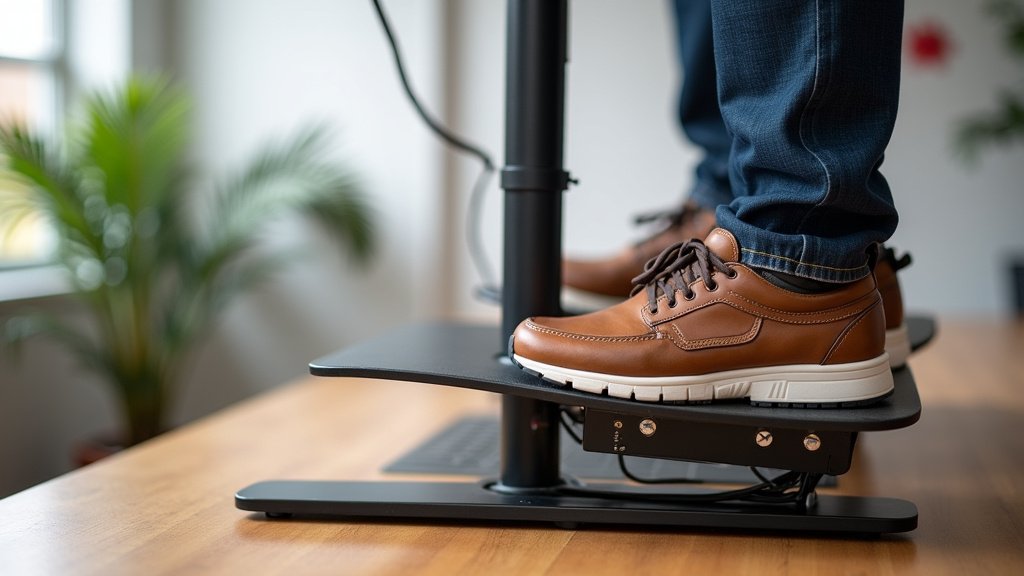
When you stand, your body naturally looks for ways to distribute your weight. Without any assistance, this distribution can put uneven stress on your joints and muscles. A footrest provides a simple way to alter this. You can place one foot slightly elevated on the rest. This subtly shifts your hip alignment and takes some pressure off your standing leg.
Many users find that resting one foot on a footrest helps them engage their core muscles a little more. It encourages a more natural, less static posture. You can easily alternate which foot is on the rest, promoting dynamic movement. This simple act of switching feet can prevent stiffness. It’s a small change that can lead to a big difference in how your body feels by the end of the day.
We’ve found that users often report a reduction in leg fatigue. They also notice less lower back pain. This is directly linked to the ability to change weight distribution. It’s like a mini-stretch or a posture adjustment without even thinking about it. This is why incorporating a footrest is more about enhancing your standing experience than contradicting it.
Types of Footrests for Standing Desks
Not all footrests are created equal, especially when paired with a standing desk. You’ll want something that fits your needs and your setup. Here are a few common types:
Adjustable Footrests
These are very versatile. You can change the angle and height of the footrest. This allows you to fine-tune your position for maximum comfort. Some even offer a rocking motion. This encourages subtle leg movements. These are great if you’re unsure about the perfect angle or height you need.
Slanted or Wedge Footrests
These typically have a fixed angle. They provide a gentle incline for your feet. This can help keep your legs from feeling completely flat and unsupported. They are often more compact than adjustable models. They are a good choice if you know the specific angle that works best for you.
Ergonomic Footrests
These are designed with your body’s natural curves in mind. They might have contours to support your arches. Some have textured surfaces for better grip. They focus on promoting healthy foot and leg alignment. These can be particularly helpful if you have specific foot comfort concerns.
Anti-Fatigue Mats as Footrests
While primarily for standing comfort, a thick anti-fatigue mat can also serve as a makeshift footrest. You can roll up a small section or simply place one foot on the edge. It offers a softer surface than a hard floor. However, it’s not as precise as a dedicated footrest for changing your stance.
Key Features to Look For in a Standing Desk Footrest
When shopping for a footrest to use with your standing desk, keep a few key features in mind. You want something that supports your goal of better posture and comfort.
Adjustability
The ability to adjust height and angle is a big plus. Your ideal position might change throughout the day. Being able to tweak the footrest ensures you can always find a comfortable resting spot. This is essential for long-term use.
Sturdy Construction
You’ll be putting weight on it, so make sure it’s built to last. Look for durable materials like metal or high-quality plastic. It shouldn’t wobble or feel flimsy. A stable footrest provides reliable support.
Non-Slip Surface
This is crucial for safety. You don’t want your foot slipping off unexpectedly. A textured or rubberized surface on the top will keep your foot securely in place. Also, check that the bottom has a non-slip base to prevent it from sliding on your floor.
Size and Portability
Consider the space under your desk. You don’t want a footrest that’s too large and gets in the way. If you plan to move it around or store it, look for something lightweight and easy to reposition.
Comfort and Ergonomics
Does it feel good underfoot? Some footrests are designed to encourage movement, like rocking or massaging features. Others offer more passive support. Consider what type of comfort you’re seeking. A footrest should feel supportive, not intrusive.
How to Use a Footrest Effectively with Your Standing Desk
Using a footrest isn’t complicated, but there are best practices to get the most benefit. The main idea is to use it for position variation, not as a permanent prop.
Start by placing the footrest under your desk. Adjust it so it’s within easy reach of your feet. When you feel the need to shift your weight or relieve pressure, place one foot on the rest. Aim for an angle that feels natural and comfortable. You don’t want to be stretching too far or straining.
The key is to switch feet regularly. Don’t leave one foot on the rest for hours. Alternate every few minutes or whenever you feel a change in your body. This continuous minor adjustment is what helps prevent fatigue and stiffness. Think of it as a gentle dance for your feet.
Some experts suggest finding a position where your knees are slightly bent. Your hips should be relatively level. The footrest can help you achieve this slight bend and weight shift. Avoid locking your knees or leaning too heavily on the rest. It’s a subtle aid, not a place to perch.
Remember, the footrest is just one part of a healthy standing desk routine. You should still aim to move around, stretch, and take short breaks. The footrest makes the standing portion more sustainable.
Potential Downsides and How to Avoid Them
While footrests are generally beneficial, there are a couple of things to watch out for. Being aware of them can help you use your footrest without any issues.
Encouraging Static Posture
The biggest pitfall is using the footrest to prop yourself in one position for too long. If you leave one foot on the rest constantly, you might create new imbalances or reduce the natural movement your body needs. Always remember to switch feet and vary your stance.
Incorrect Height or Angle
If the footrest is too high or too low, or at the wrong angle, it can actually cause discomfort. It might put your hips out of alignment or strain your calf muscles. Experiment to find the sweet spot. What feels good for one person might not be ideal for another. A little trial and error is usually necessary.
Tripping Hazards
If the footrest is placed carelessly, it can become a tripping hazard. Make sure it’s positioned so you can easily move your feet. If you often step away from your desk, consider if you need to move the footrest. Some models are designed to tuck away neatly.
Floor Damage
A footrest with rough feet or a poor base could potentially scratch or damage your flooring. Always check the material of the footrest’s base. Many good ones have rubber or felt padding to protect your floor. Using an anti-fatigue mat underneath can also provide an extra layer of protection.
A Quick Checklist for Footrest Happiness
Here’s a quick rundown to ensure your footrest experience is a good one:
- Adjustability is key: Look for height and angle options.
- Sturdiness matters: It should feel solid and reliable.
- Safety first: Ensure a non-slip surface and base.
- Size it up: Make sure it fits your workspace.
- Switch it up: Alternate feet to avoid static positions.
- Listen to your body: Adjust until it feels comfortable and supportive.
Incorporating a footrest into your standing desk setup can be a simple yet effective way to boost your comfort and endurance. It’s about finding a balance and making standing a more dynamic and less fatiguing activity. By choosing the right footrest and using it wisely, you can make your standing desk experience even better.
Conclusion
You’ve seen that using a footrest with your standing desk is not only possible but can greatly enhance your comfort and endurance. It’s a practical tool for varying your stance and reducing fatigue, transforming long standing periods into more dynamic, less taxing experiences. By selecting a footrest with the right features and using it to switch positions regularly, you can avoid static posture and keep your body feeling better. So, take that step – find a footrest that suits your needs and start making your standing desk setup work even harder for your well-being.
Frequently Asked Questions
Will a footrest make me stand less?
Not if you use it correctly! A footrest is designed to make standing more comfortable by allowing you to shift weight and posture. It helps you stay upright longer by reducing fatigue, rather than encouraging you to sit.
Can I use any footrest with a standing desk?
While many footrests work, it’s best to choose one that’s adjustable, sturdy, and has a non-slip surface. These features ensure safety and allow you to find the ideal position for comfort while standing at your desk.
How often should I switch feet on the footrest?
Aim to switch feet every few minutes, or whenever you feel the need to shift your weight. The goal is to encourage dynamic movement, not to prop one leg up indefinitely. This constant adjustment is key to preventing stiffness.
What if my footrest causes my hips to feel uneven?
This usually means the height or angle isn’t quite right for you. Experiment with different adjustments until your hips feel relatively level and your knees are slightly bent. A footrest should support a comfortable, balanced posture.
Is an anti-fatigue mat the same as a footrest?
An anti-fatigue mat primarily provides a cushioned surface for standing. While you can use its edge to prop a foot, it doesn’t offer the same level of positional variation or support for shifting weight as a dedicated footrest.